
Quick Steps: how to remove inquiries from your credit report

So, you're looking to clean up your credit report and noticed a few inquiries you don't recognize. The first thing to know is that you can absolutely challenge unauthorized or fraudulent hard inquiries. The Fair Credit Reporting Act (FCRA) gives you the right to dispute anything on your report that is inaccurate or the result of identity theft.
But here’s the catch: you can't remove legitimate inquiries that came from applications you actually submitted. Those are there to stay, but thankfully, not forever. Let's break down what you're really looking at.
Understanding Hard Inquiries and Their Real Impact

Before you start drafting dispute letters, it’s essential to know what you’re dealing with. Not all credit checks are the same, and understanding the difference is your first move toward a smarter strategy.
Every time a company looks at your credit file, it leaves a footprint called an inquiry. These fall into two buckets: hard inquiries and soft inquiries. Getting a handle on how they work is key.
Hard vs Soft Credit Inquiries At a Glance
To make it simple, here's a quick comparison of the two types of inquiries you'll see on your credit report.
Understanding this distinction is the most important part of the process. You're only concerned with the hard inquiries that you didn't authorize.
A soft inquiry (or soft pull) is essentially a background check. It happens when you check your own credit, a company pre-screens you for an offer, or a potential employer runs a check (with your permission). These have zero effect on your score.
On the other hand, a hard inquiry (or hard pull) gets recorded when you formally apply for new credit. When you fill out that application for a mortgage, car loan, or credit card, you’re giving the lender permission to dig into your full credit history. This tells the credit bureaus you're actively trying to borrow money. For a deeper dive, you can read our detailed guide on what a credit inquiry is.
Why Lenders Pay Attention to Hard Inquiries
From a lender's perspective, a bunch of hard inquiries in a short time can be a red flag. It might signal that you're in financial trouble or trying to take on more debt than you can handle. This can make you look like a riskier borrower, which might hurt your score and even lead to a denial.
This is precisely why people want to know how to get these inquiries removed. While one hard pull might only ding your score by a few points, several of them can start to add up.
The good news? The impact is usually small and short-lived. Inquiries only account for about 10% of your FICO score's calculation. They remain on your report for two years, but their effect on your score usually fades much faster, often in just a few months.
The "Rate Shopping" Exception You Should Know About
Credit scoring models from FICO and VantageScore are smart. They understand that savvy consumers shop around for the best rates on big-ticket loans.
If you’re hunting for a mortgage or auto loan, you’ll naturally apply with a few different lenders to compare offers. To avoid penalizing you for this, the scoring models typically group multiple inquiries for the same type of loan within a short period (usually 14 to 45 days) and treat them as a single event.
This lets you find the most competitive interest rate without worrying about your credit score taking a nosedive. It's a consumer-friendly feature built right into the system.
Finding the Inquiries You Can Actually Dispute
First things first, you need to figure out which inquiries are fair game for a dispute. Not every hard inquiry on your credit report can be removed, so the initial goal is to comb through your files and separate the legitimate credit checks you approved from the ones that don't belong. This is all about focusing your energy where it will actually count.
Your first move is to get your hands on your credit reports. You can pull a free copy from each of the big three bureaus—Equifax, Experian, and TransUnion—every single week. The only place you should go for this is the official, federally-backed site: AnnualCreditReport.com.
Here’s what the homepage looks like, just so you know you’re in the right spot. It's simple and direct.
Stick to this government-mandated site to get your reports without getting roped into paying for something that's rightfully yours for free.
What to Look for in the Inquiry Section
Once you have your reports, hunt for the section called "Credit Inquiries" or "Hard Inquiries." It's basically a log of who's been peeking at your credit history.
Each line item will give you the essentials:
Now, put on your detective hat. You need to go through this list, one by one, and cross-reference it with your own memory. For each inquiry, ask yourself a simple question: "Did I actually apply for something around this date that would have required a credit check?"
Spotting the Good, the Bad, and the Ugly
This is where a sharp eye pays off. Most of the inquiries you see will likely be perfectly legitimate, which means they’re staying put.
Legitimate inquiries are usually pretty obvious. Applied for a new credit card in March and see a pull from that bank in March? That’s legit. Went car shopping in July and see a few inquiries from different dealerships? Those are almost certainly yours.
What you're really looking for are the red flags—the inquiries that just don't add up.
It’s important to remember there’s no magic number for how many hard inquiries is “too many,” but lenders do get nervous when they see a lot of recent applications. While these hard pulls can ding your score, soft inquiries—like when you check your own score or a company pre-approves you for an offer—have zero impact. Millions of items get disputed from credit reports every year, and that absolutely includes faulty inquiries. You can get more details on how credit inquiries work and their real impact from resources like American Express.
A Quick Real-World Example
Let's say you're looking at your TransUnion report and see an inquiry from "ABC Auto Finance" from two weeks ago. The problem? You haven't set foot in a car dealership in over a year. That right there is a perfect candidate for a dispute. It's an unauthorized pull that could be a simple mistake or something more serious.
On the other hand, you also see an inquiry from "XYZ Bank" from last month. You immediately remember applying for their travel rewards card online. That's a legitimate inquiry. Trying to dispute it would be a waste of time, because the bank will simply verify it, and it will stay right where it is.
By taking the time to carefully audit your reports, you build a clear, actionable list. You'll know exactly which inquiries to go after and can avoid the frustration of fighting battles you can't win.
A Practical Guide to Disputing With Credit Bureaus
So, you’ve combed through your credit reports and found an inquiry that doesn’t look right. Now what? It’s time to take action. This isn’t about just waiting and hoping it goes away; you have the right under federal law to challenge these marks on your credit file.
The secret to a successful dispute is creating a rock-solid record of your communication. While you can often dispute errors online, I always tell people to use certified mail with a return receipt requested.
It might feel a little old-school, but this method creates a legal paper trail that is undeniable. That little green return receipt is your proof of when the credit bureau received your letter, and that’s what starts a very important clock.
This quick infographic breaks down the first part of the process—finding what you need to dispute in the first place.
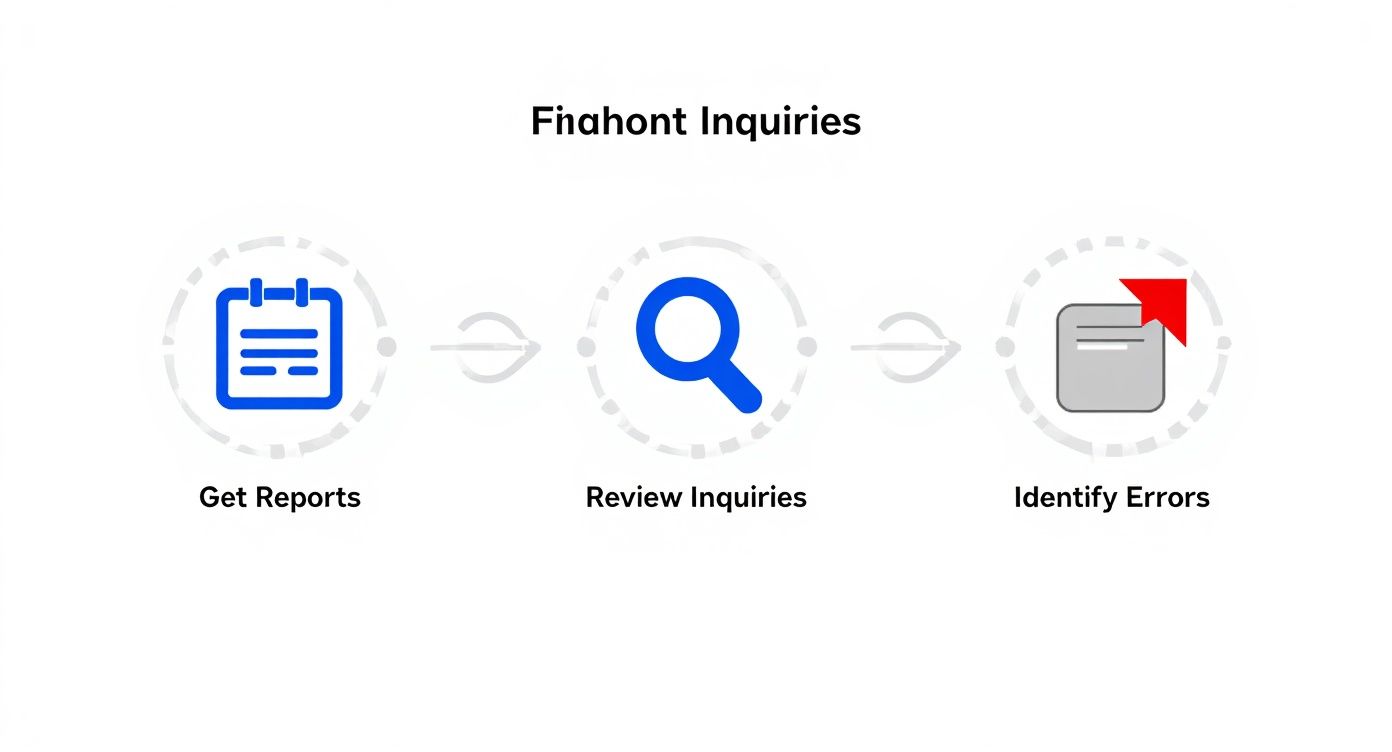
As you can see, it all starts with a careful review. You can't challenge an error you haven't found, so digging into your official reports is the foundational first step.
Crafting Your Dispute Letter
A well-written dispute letter is your most powerful tool. The key is to be professional, clear, and straight to the point. This isn't the place for emotional appeals or long, winding stories. Just stick to the facts and provide your evidence.
Your letter absolutely must include these key details:
For those dealing with broader data privacy issues, some people turn to professional personal information removal services which can help with cleaning up various types of online and financial records.
Your Dispute Contacts
To make things easier, here is the contact information you'll need to mail your dispute letters. You can also find links to their online dispute portals if you choose to go that route.
Credit Bureau Dispute Contact Information
Having this information handy saves you a ton of time searching around when you're ready to send your packets.
The Investigation Timeline You Need to Know
Once a credit bureau gets your dispute letter, a timer starts. Under the Fair Credit Reporting Act (FCRA), they are legally required to investigate your claim, usually within 30 days.
During this window, the bureau will reach out to the creditor who reported the inquiry. They'll ask them to verify it. It's then on the creditor to respond and provide proof that the inquiry was legitimate.
If the creditor can't prove it—or if they simply don't respond in time—the credit bureau must remove the inquiry from your report. This is exactly why your clear, well-documented dispute is so important; it shifts the burden of proof onto the creditor.
What to Expect After 30 Days
Once the investigation wraps up, the credit bureau has to send you the results in writing. If your dispute led to a change, this letter will also come with a free copy of your updated credit report.
You'll get one of three outcomes:
Learning how to dispute items on your credit report is a vital skill for anyone serious about their financial health. For a more comprehensive look at the process, take a look at our guide on how to dispute credit report errors of all kinds. Staying organized and knowing your rights are the keys to effectively cleaning up your credit history.
How to Ask the Creditor for a Goodwill Removal

While fighting errors with the credit bureaus is a formal, evidence-based process, sometimes a more personal touch works wonders. You can reach out directly to the company that made the inquiry and simply ask for a "goodwill" removal. It's a human-to-human appeal that can be surprisingly effective, especially if the inquiry stemmed from a simple mistake.
Think about it: the creditor put the inquiry on your report in the first place. If you can persuade them to retract it, they can tell the bureaus to delete it. This approach can often sidestep the need for a drawn-out formal investigation.
This strategy really shines in certain scenarios. Maybe a car dealership ran your credit twice by accident during a single visit. Or perhaps a bank teller initiated a hard pull when you were just asking for some basic loan information. In these clear-cut cases, a polite request is often the fastest way to clean up your report.
Finding the Right Person to Contact
Your first hurdle is making sure your request doesn't get lost in a customer service black hole. Calling the main 1-800 number usually won't cut it; the agents you speak with rarely have the authority to handle these specific credit reporting issues. You need to aim higher up the chain.
Start by digging around on the company's website for a corporate mailing address or a dedicated customer relations department. If you hit a dead end, a quick search on LinkedIn for a manager in "credit operations" or "underwriting" can sometimes give you the name and title you need to address your letter properly.
Here are a few good places to direct your efforts:
Crafting a Compelling Goodwill Letter
A goodwill letter is your chance to state your case politely and professionally. The trick is to be concise, factual, and friendly. You’re not demanding anything; you're making a respectful request based on your good standing with their company.
Always type your letter and include all the key information they’ll need to pull up your file. Most importantly, keep the tone positive and avoid sounding confrontational.
Your letter should clearly lay out a few key things: