
How Long of Credit History Is Good for Your Score

So, how long is long enough when it comes to your credit history? While there isn't a single magic number, most lenders like to see a track record of at least 2-5 years of responsible borrowing.
If you can show a history that stretches beyond 7-10 years, you're in an even better spot. That kind of long-term consistency is often considered excellent and signals real financial stability.
What Lenders Consider a Good Credit History Length
Think of your credit history as a financial resume. A recent college grad might have tons of potential, but an applicant with a decade of proven success in their field is often seen as a much safer bet. Lenders look at your credit history the same way—a longer one gives them more data to feel confident about your ability to handle debt.
This is exactly why the length of your credit history is a key ingredient in your credit score. It accounts for a solid 15% of your FICO score, which is the model used by 90% of top U.S. lenders. The influence is even greater with VantageScore, where it makes up about 20% of the score.
Scoring models don't just look at one number. They analyze a few different things: the age of your oldest account, the age of your newest account, and, most importantly, the average age of all your accounts combined. You can find more details on how your credit history is calculated on Bankrate.com.
The Key Milestones for Credit Age
Lenders tend to view credit history in stages, almost like levels of experience. Each stage tells them something different about your reliability as a borrower.
Here’s a quick look at how lenders often categorize different lengths of credit history and what each tier generally means for you.
Credit History Length Benchmarks
Basically, the longer you can demonstrate responsible credit management, the more comfortable lenders will be. A history that’s just a couple of years old is a good start, but crossing that seven-year mark is what really opens doors to the best products and lowest interest rates.
How Your Average Account Age Is Calculated
When lenders pull your credit report, they don't just glance at the date you opened your very first credit card. What they're really interested in is your average account age, which is calculated across all your open credit lines.
Think of it like calculating the average age of a group of people. One person who's 50 years old will raise the average, but adding a few 20-year-olds to the mix will pull that average down pretty quickly. It's the same with your credit accounts.
The Three Key Ingredients of Your Credit Age
So, what exactly goes into this calculation? Credit scoring models look at three specific pieces of information to figure out your average credit age.
This infographic breaks down how a credit profile matures over time, evolving from brand new to excellent.
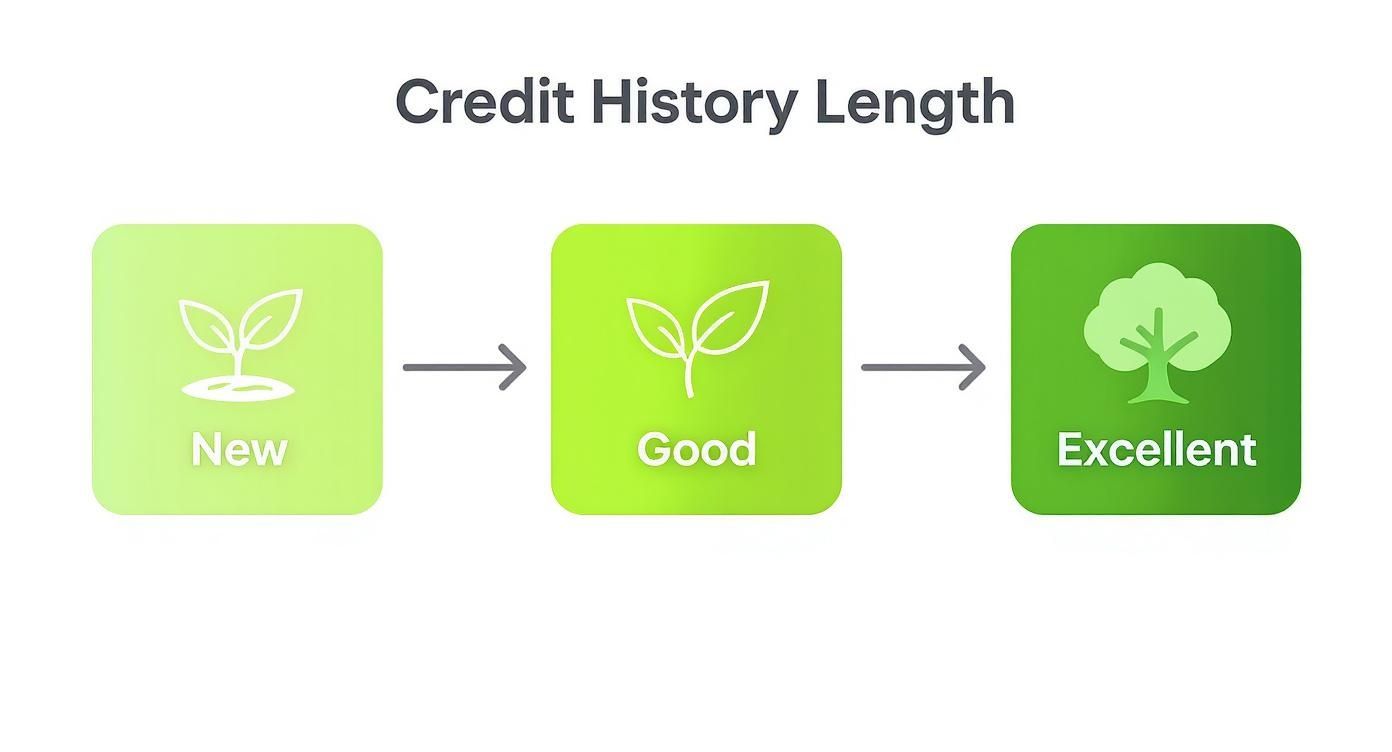
As you can see, a longer, more established history is viewed as far more reliable—kind of like how a deep-rooted, mature tree is much sturdier than a brand-new seedling.
Let's look at a quick example. If you have just one credit card that's 10 years old, your average account age is a solid 10 years. But if you open a new card today, your average age instantly plummets to just five years (10 years + 0 years, divided by 2 accounts). This is a big reason why a longer credit history often leads to a higher credit score.
This isn't just theory, either. While the average U.S. credit score is around 717, that number changes a lot by age. Consumers in their 40s, who often have two decades of credit experience, typically have higher scores than people just starting out. It's proof that a long track record of responsible borrowing really pays off.
This mix of old and new accounts showing up on your report are often called tradelines. Getting familiar with how credit report tradelines work will give you a much clearer picture of what lenders see when they size up your credit profile.
Common Mistakes That Can Shrink Your Credit History
It takes years of patience to build a solid credit history, but it only takes one or two simple mistakes to set you back. When you're trying to figure out how long of a credit history is good, remember that protecting the age of your accounts is just as crucial as opening them in the first place.

One of the most common pitfalls is closing an old, unused credit card. It might feel like responsible financial housekeeping, but it can be one of the worst things you do for your credit age. When you close your oldest account, you're essentially removing the anchor that gives your average account age its weight.
Think about it this way: if you have one card that’s 12 years old and a newer one that’s 2 years old, your average account age is a healthy 7 years. If you close that old card, your average age plummets to just 2 years. In an instant, you've wiped out years of hard-earned history.
How to Protect Your Oldest Accounts
So, what’s the alternative to shutting down that dusty old card? The trick is to simply keep it active and in good standing.
Now, there is a bit of a safety net. According to Experian, accounts closed in good standing can stay on your report for up to 10 years, so they’ll continue to contribute to your credit age during that time. But here's the catch: they stop aging the day you close them, and after a decade, they vanish completely.
That's why keeping those foundational accounts open is such a critical long-term strategy for a healthy credit score.
Actionable Steps to Build Your Credit History Now
Creating a solid financial track record from scratch can feel a little daunting, but you can build a strong credit history faster than you might think with the right game plan. There are a few safe and really effective ways to show lenders you're reliable, even if you have no credit to your name.
One of the most popular and powerful strategies is to become an authorized user on a credit card belonging to a trusted family member. When they add you to their account, you essentially get to "borrow" the positive payment history and age of their card on your own credit report. It’s a fantastic way to get an instant boost, as long as the main cardholder has a long and spotless record.
Proven Methods for New Credit Builders
If you’d rather build credit all on your own, you’ve got some great options. Each of these tools is designed to help you create a positive payment history, which is the single most important piece of your credit score.
Choosing the right path really depends on your personal situation, but mixing and matching methods can often speed things up. For instance, becoming an authorized user while also managing your own secured card can create a much stronger credit profile. For a deeper dive, you can learn more about how long it takes to build credit and get a better sense of the timeline.
How to Protect and Grow Your Existing Credit Age
Once you have a few accounts open, the game changes. It's no longer about just getting started; it's about carefully nurturing what you've built. Think of your credit age like a fine wine—it gets better and more valuable over time, but only if you handle it correctly. The number one rule? Keep your oldest credit accounts open. Period.

It’s tempting to close an old credit card you no longer use, especially one with a zero balance. Don't do it. This is one of the most common and damaging mistakes people make. Closing that account is like chopping down the oldest tree in your garden; it instantly erases years of positive history and can cause your average account age to nosedive. That old account is the anchor of your entire credit profile.
So, what should you do with that old, dusty card? Use it, but strategically. You don't need to make big purchases. Just charge a small, recurring bill to it—think Netflix, Spotify, or your monthly coffee fund.
Then, set up autopay to clear that small balance in full each month. This tiny bit of activity keeps the account active and in good standing, ensuring it continues to report positive payment history to the credit bureaus. It’s a simple trick that preserves your hard-earned credit history.
Smart Habits for a Mature Credit Profile
Protecting your credit age is a big piece of the puzzle, but it’s not the only piece. A long history is most impressive when it's paired with other responsible financial habits. You want to show lenders not just that you've been around the block, but that you've navigated it wisely.
These habits work hand-in-hand to build a rock-solid financial reputation:
Nurturing your credit is about more than just one factor. To see how all these pieces fit together, it’s worth learning more about how to maintain good credit through consistent, positive actions.
Impact of Actions on Average Credit Age
Your everyday financial decisions can either help or hurt your average credit age. Here's a quick breakdown of how common actions play out over time.
Ultimately, the goal is to play the long game. Avoid impulsive decisions like closing old cards, and be strategic when adding new ones to your profile. This approach ensures your credit history continues to mature and work in your favor.
Answering Your Questions About Credit History
Even when you know the basics of credit age, some tricky questions always seem to pop up. Let's walk through a few of the most common ones so you can manage your credit with confidence.
Can I Have a Good Score with a Short History?
Yes, you definitely can. It's entirely possible to get a good credit score—think high 600s or low 700s—with just a few years of history. Reaching the truly elite tier of 800 and above, however, is a different story; that almost always requires a longer track record.
When your credit file is young, the other scoring factors carry much more weight. Lenders will zoom in on two things in particular:
Nailing these two categories can help you build a solid score surprisingly fast. But for the absolute best loan terms and interest rates, there's no substitute for a seasoned credit history built over time.
Does Closing My Newest Card Help My Average Age?
It's a logical question, but the answer is no, not really. Closing your newest credit card won’t give your average account age a meaningful boost. The calculation includes all of your accounts, so removing one young one barely moves the needle.
The real risk is closing your oldest accounts. That can slash your average age and send your score tumbling. And while shutting down a new card won't hurt your credit age, it does lower your total available credit. This can push your credit utilization ratio higher, which is a key factor that could ding your score. The best move is usually to keep all your accounts open and in good standing.
How Long Until My Credit History Is Excellent?
There’s no magic number, but most experts agree that it takes at least 7 to 10 years of consistent, responsible credit use to be seen as having a long or "excellent" history.
That's enough time to show a clear, reliable pattern of on-time payments across various types of credit. An excellent history isn't just about age, either—it’s also about having a healthy mix of accounts (like credit cards and installment loans) and a proven commitment to keeping your debts low.
Ready to build and monitor your credit history with confidence? itin score is the first credit-building platform designed for ITIN holders. Get free credit monitoring, personalized insights, and a clear action plan to achieve your financial goals. Start building your U.S. credit history today at itinscore.com.